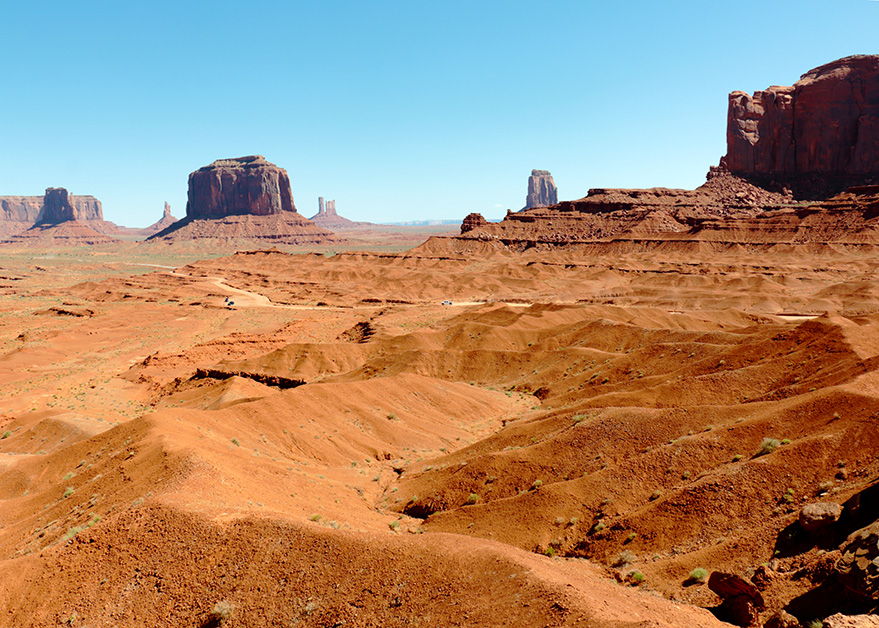
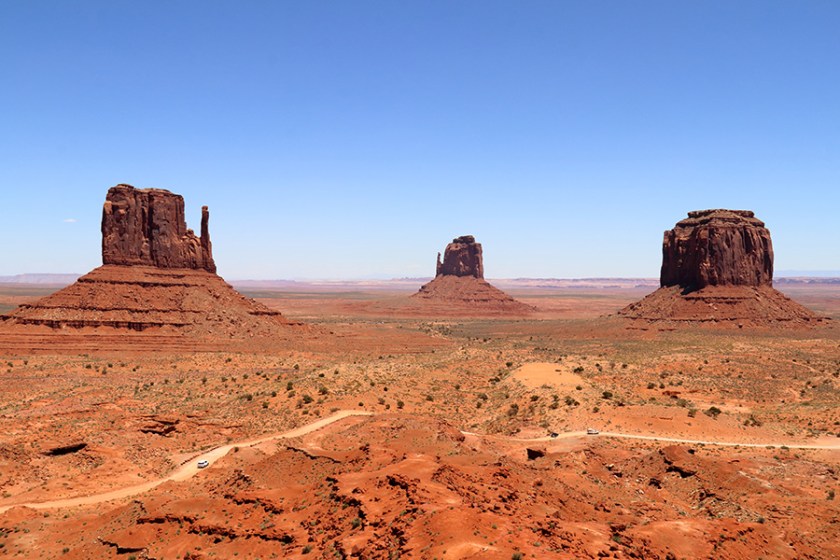
During the dark days of COVID when most of the UK population was stuck at home, I yearned to get out of the house and see the outdoors. I wanted varied landscapes where everything was dramatically different to England. I wanted awe inspiring scenery, unusual scents, unfamiliar sounds, foods never tasted before and to meet people with stories to tell. Images of arid yellow land, red sandy layers and rocky terrain called loudly to me – the South-West of the United States of America.
MY PREPARATION
I searched online for coach tours that covered all the places I wanted to visit in the US, but found nothing suitable. My ‘Plan B’ involved ‘Fly/Drive’ but once again I couldn’t find a route I liked and, to be honest, felt nervous at the thought of driving on US roads. But nothing ventured, nothing gained.
Planning a road trip – how I started
I ordered road maps of SW America via Amazon. Spreading out the maps, I marked places to visit with sticky notes. I was very shocked to see many yellow marks littering a vast area. You need to to make some tough decisions on which places to visit. I looked for any groupings that were close to each other so I could begin creating a route.
I wanted to see old Santa Fe, stunning Monument Valley, at least one old American steam railway, the incredible Bisti Badlands, and UNESCO Mese Verde. I dropped Grand Canyon, Bryce National Park, Arches NP and Paige. They were too far from my starting point of Santa Fe. In a trip of this length you need to allow for travel time and plenty of time to rest and enjoy.
Key Tip: Joining ‘The American Southwest Group’ (505.4K members) was invaluable for information. The members gave brilliant suggestions on everything I needed to know about the area.
Using a spreadsheet, I created an outline of my road trip. I listed places to visit, checked distances and actual travelling time with Google Maps. Allow plenty of time to do this. It helps to identify what is possible in the time you have allowed for your trip.
Feedback from the Facebook group indicated that my first plan was too ambitious in the time allotted! So I brought my partner into the planning to get his input and advice. A few more discussions, and the list became much smaller and more balanced.
I visited my local travel agent (Trailfinders) at the end of December to start the process. I needed to find the best deal (return flights per person from £780+) and routing to meet my deadline of mid-May. Once the flights were paid for in early January, it was a mad rush to book all the hotels and experiences that I wanted.
A big learning was that some attractions don’t open until early May in the SW of America. Partly to do with the weather which can be still wintry but also because it is the beginning of the US school holidays. Bisti Badlands is an area of outstanding beauty, a photographer’s dream but difficult to get to. It’s a drive of over 5 miles on rough roads but US hire cars only cover tarmac roads – not gravel or mud. So if you breakdown there would be no support. So I had to drop this place. Something I regret. Long after the holiday I discovered that you could hire locally vehicles for off road drives in Farmington. Duh!
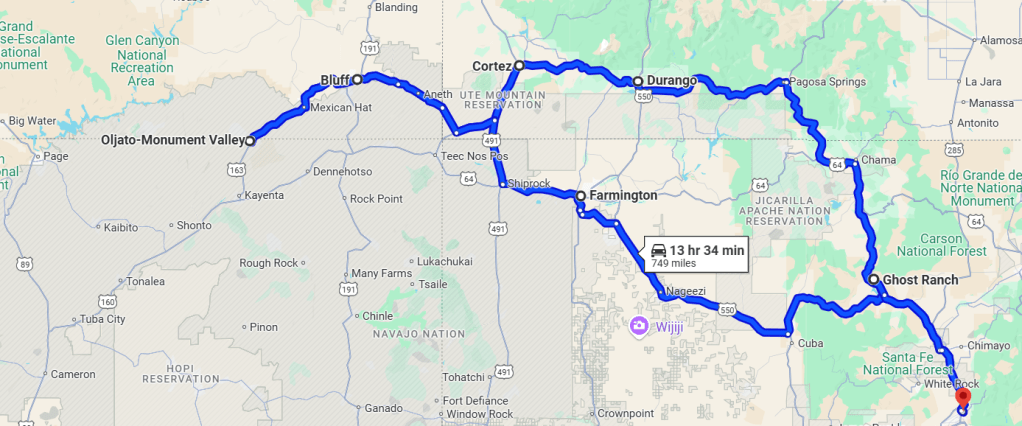
Here is the route we took for our holiday.
THE ROAD TRIP
Day 1 – Do you know the way to Santa Fe?
Our 9-hour long flight from Heathrow to Denver ended in a long stopover. It was useful, as it gave us time to stretch our legs before the next part of the trip.
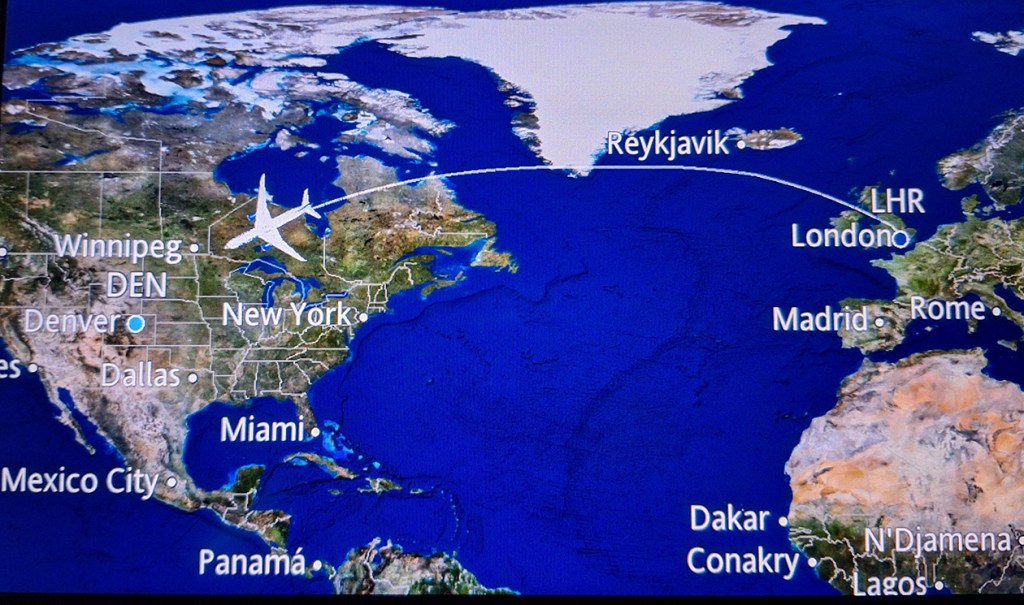
Denver is a very busy airport hub. People dashing along travellators with all types of baggage, children playing in waiting areas, and air staff manning desks. Plenty to watch. Our next short flight (c. 1 hr) from Denver to Santa Fe, was severely delayed. The next cabin crew had yet to arrive from Houston. He came on a flight going through thunderstorms in order to join us. When he arrived, he received a huge round of applause from all the waiting travellers.
It was after 9.30pm before we actually landed in Santa Fe Airport. The baggage section was pretty basic: a shed with wooden seats and an angled wooden roller conveyor. Santa Fe Airport is undergoing a major modernisation project so things will change in future.
It’s a small airport, so there is no taxi rank at night or Uber. You need to reserve a taxi beforehand. I contacted many companies prior to our holiday and was outraged at quoted prices. Our taxi, (from Robs’s Rides LLC) who were recommended to us, despite our delayed flight, still met us at the airport plus a stray traveller, talking us all to downtown Santa Fe.
Key Tip: prices for taxis in the evening are very high, so I used a car firm recommended by our hotel, Rob’s Rides LLC, Rob. They were a friendly bunch. I discovered Rob is from Nepal as are some of his drivers. Their service was excellent and they were very helpful.
After 10pm, we finally gained access to our room in a small hotel called The Parador. Despite being in a lovely room, jet lag made it difficult to sleep. But as dawn arrived, I heard bird song outside our room. I opened the window and marvelled at the fresh blue New Mexico sky above and felt the warmth of the air on my face. I felt utter joy at knowing I was finally here, in South-west America. A very sweet moment. The first stop of our new adventure.
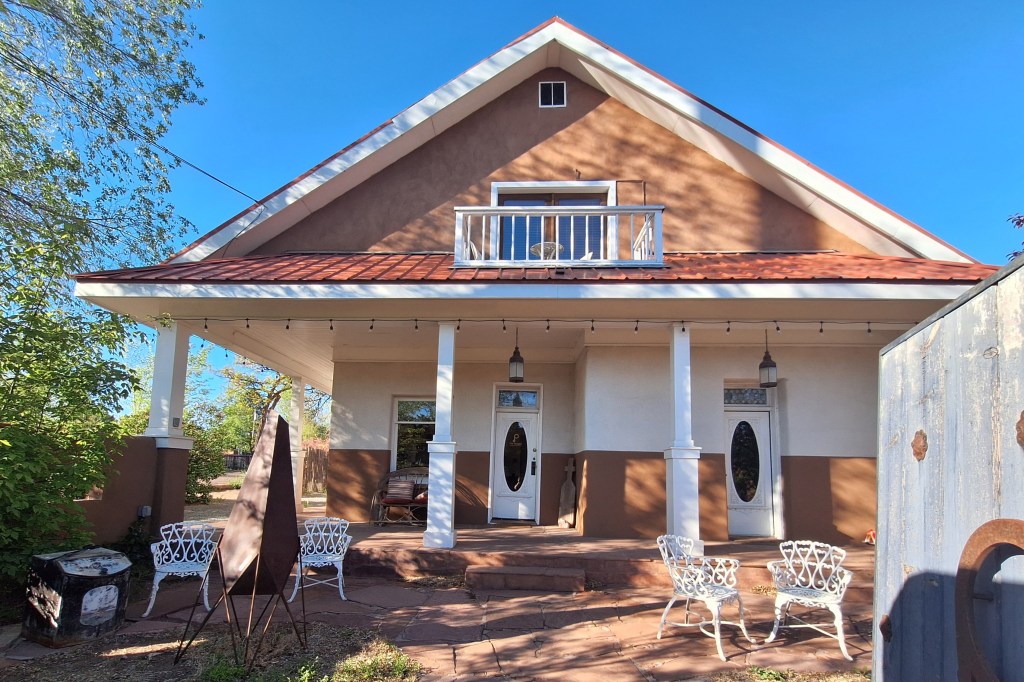
Day 2 – Taking it slow and easy
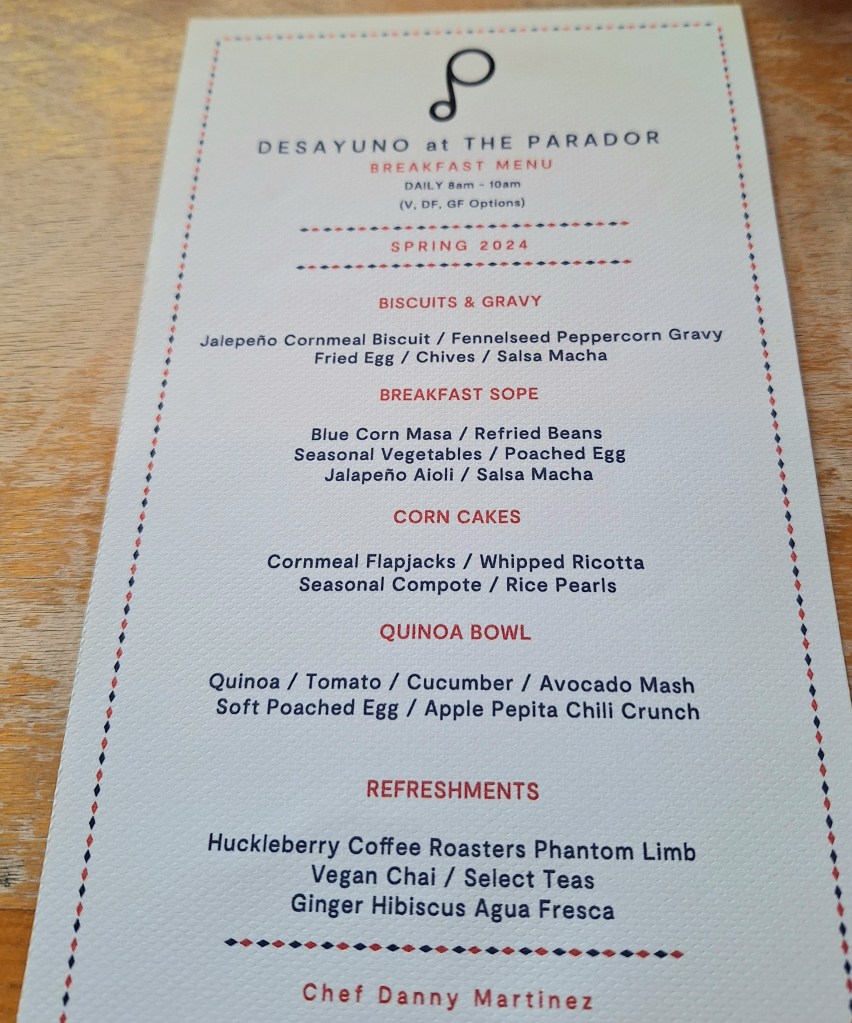
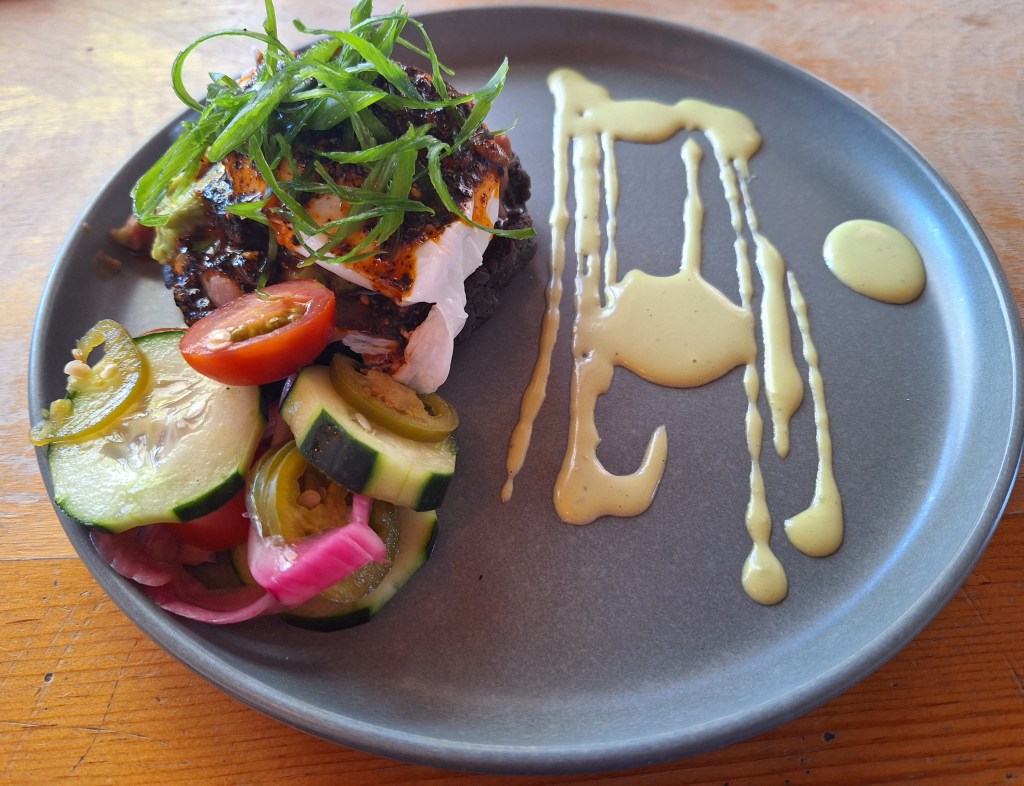
Breakfast started at 8am. Every morning turned out to be a voyage of culinary discovery. Our menu listed items such as Breakfast Sope (blue corn masa, refried beans, seasonal vegetables, poached egg, jalapeno aioli, and salsa macha) and Corn Cakes (cornmeal flapjacks, whipped ricotta, seasonal compote, and rice pearls). Santa Fe has a culinary college so that may explain the exceptional cooking we experienced at the hotel. It was amazing!
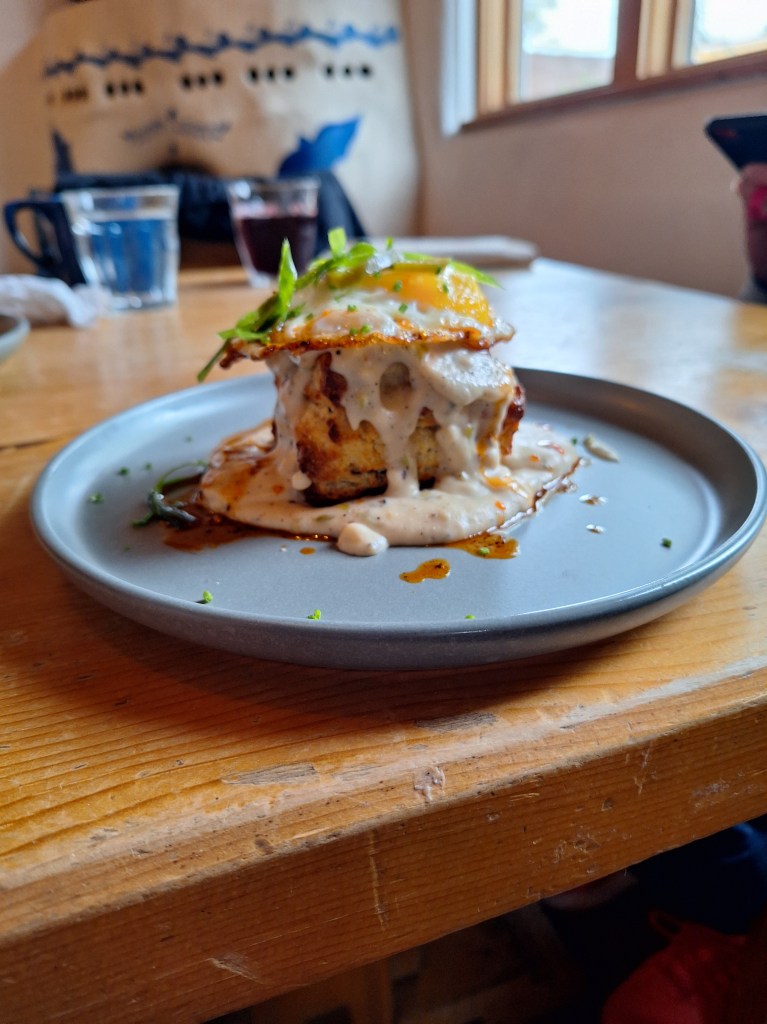
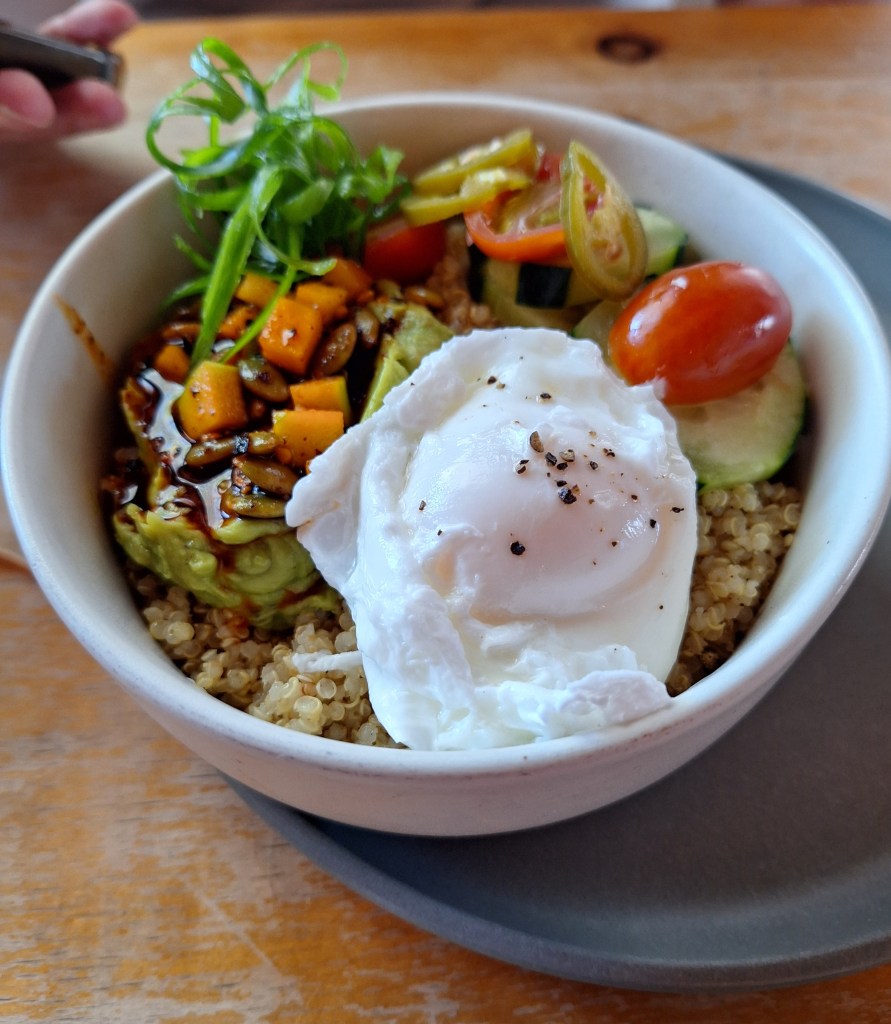
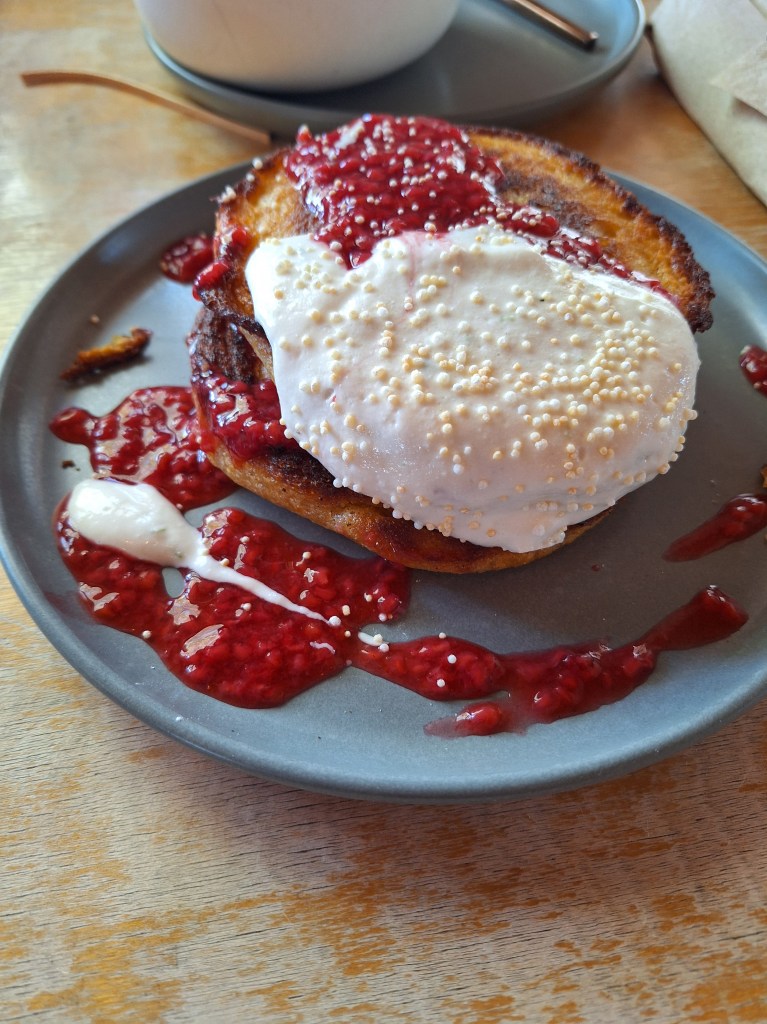
Key Tip: When you first arrive In Santa Fe, it is important to take it easy for at least 48 hours and drink a great deal of water. This town is at an altitude of 7,000 feet! That’s higher than Ben Nevis at 4,143ft! I couldn’t get my head round this. New Mexico is a desert region but is higher than many European towns.
My husband and I are both aged 60 years, so we needed to rest. The combination of jet lag and the altitude was keenly felt.
Our exploration of Santa Fe began early evening. We visited the ‘Five and Dime’ store first to buy sun cream, pills and more water for the days ahead. Santa Fe’s old town is not very big, so my chosen Santa Fe restaurant for the evening was just a few blocks away. I selected El Charro on West Alameda Street because of the excellent TripAdvisor reviews. Luckily the wait was short. The food and service were great. American servers are very attentive and regularly check that you are pleased with everything. We ate from enormous plates of fine tasting ribs and Caesar salad. No surprise that this restaurant/bar was busy all night. It is customary to leave tips of 15-20%.
Key Tip: Consider using #TripAdvisor to get ideas on where to visit and always read reviews.
Day 3 – Getting some wheels
Our main task on Day 3 was to collect the hire car from the airport and begin driving on American roads. Our first time! We collected a Ford Edge SUV hire car through #Booking.com/Avis.
Key Tip: Always photograph your hire car before your journey so you have records of any dents/scratches. Ask for information on how to use the gears and how to fill your car up with fuel.
I admit I did have plans to do a small journey on Day 3. To travel south on NM14 and visit the villages in the Turquoise Trail, and find a bit of Route 66 at Clines’ Corner. But jet lag and lack of sleep left me with no energy and confidence for doing this day trip. We decided to walk round the pretty, very old town of Santa Fe (founded in 1610).
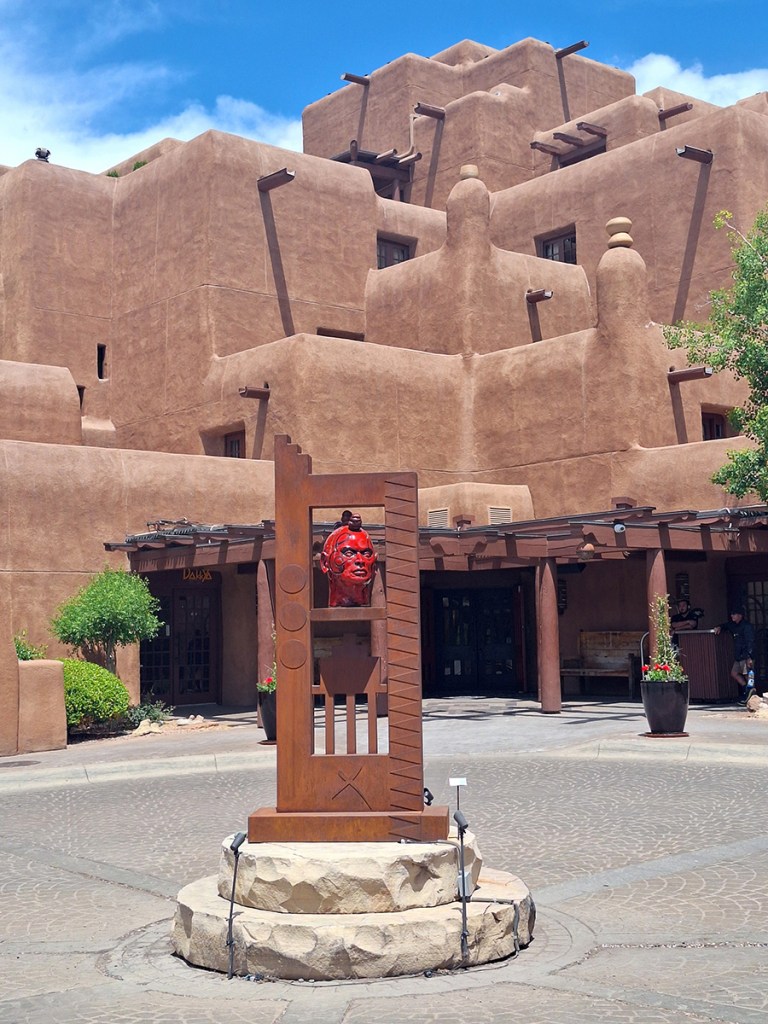
There are a lot of adobe style buildings. Thick mud walls to keep heat out during the summer and to keep the heat in the winter. We found it rather warm when we visited in May and were glad to find that many of the buildings have covered walkways to keep the sun off you. It was like a very warm UK summer’s day.
Key Tip: Bring a good sun hat. We walked around the old town on a warm day of 24 degrees. We kept to the shade where possible.
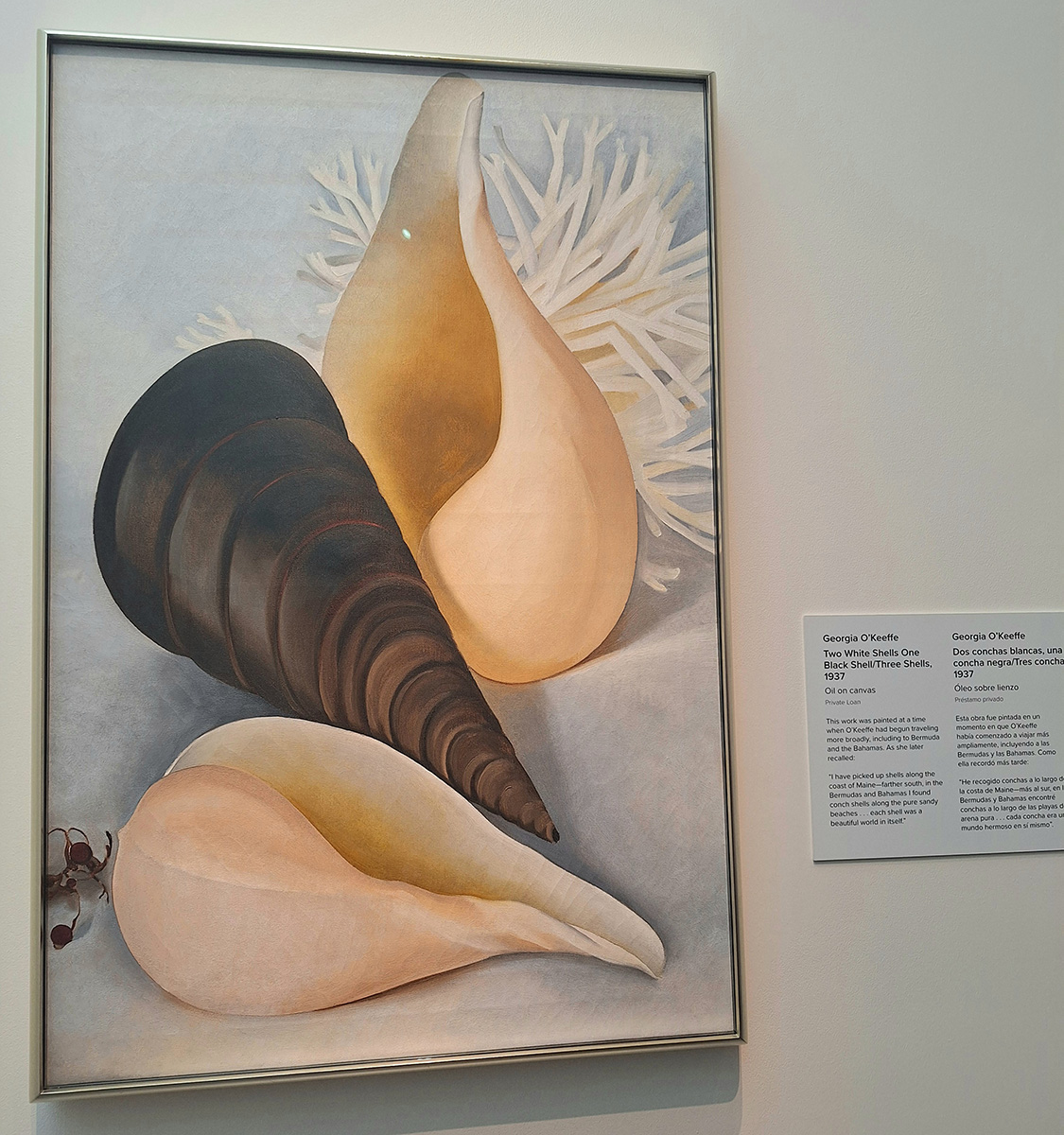
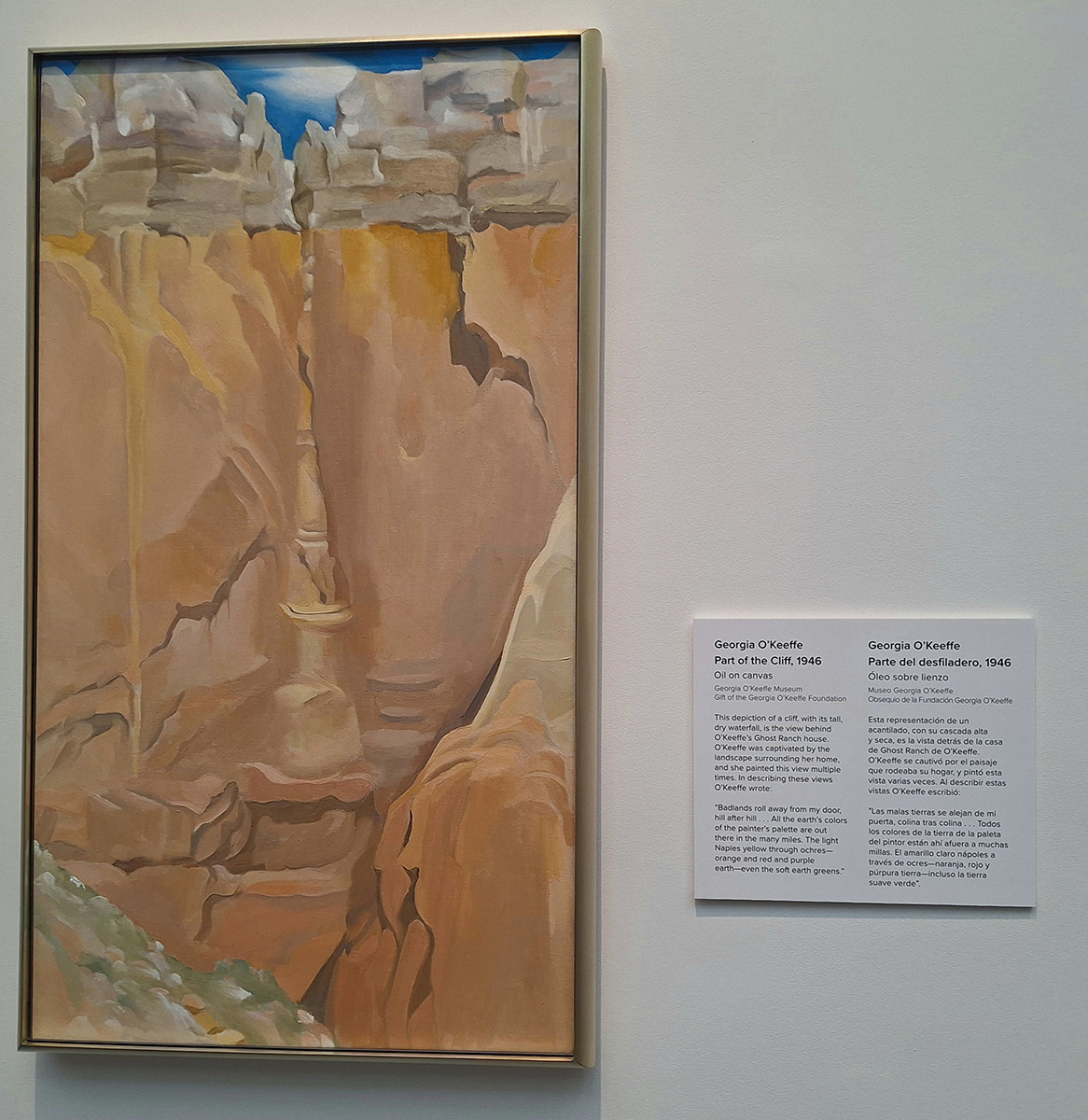
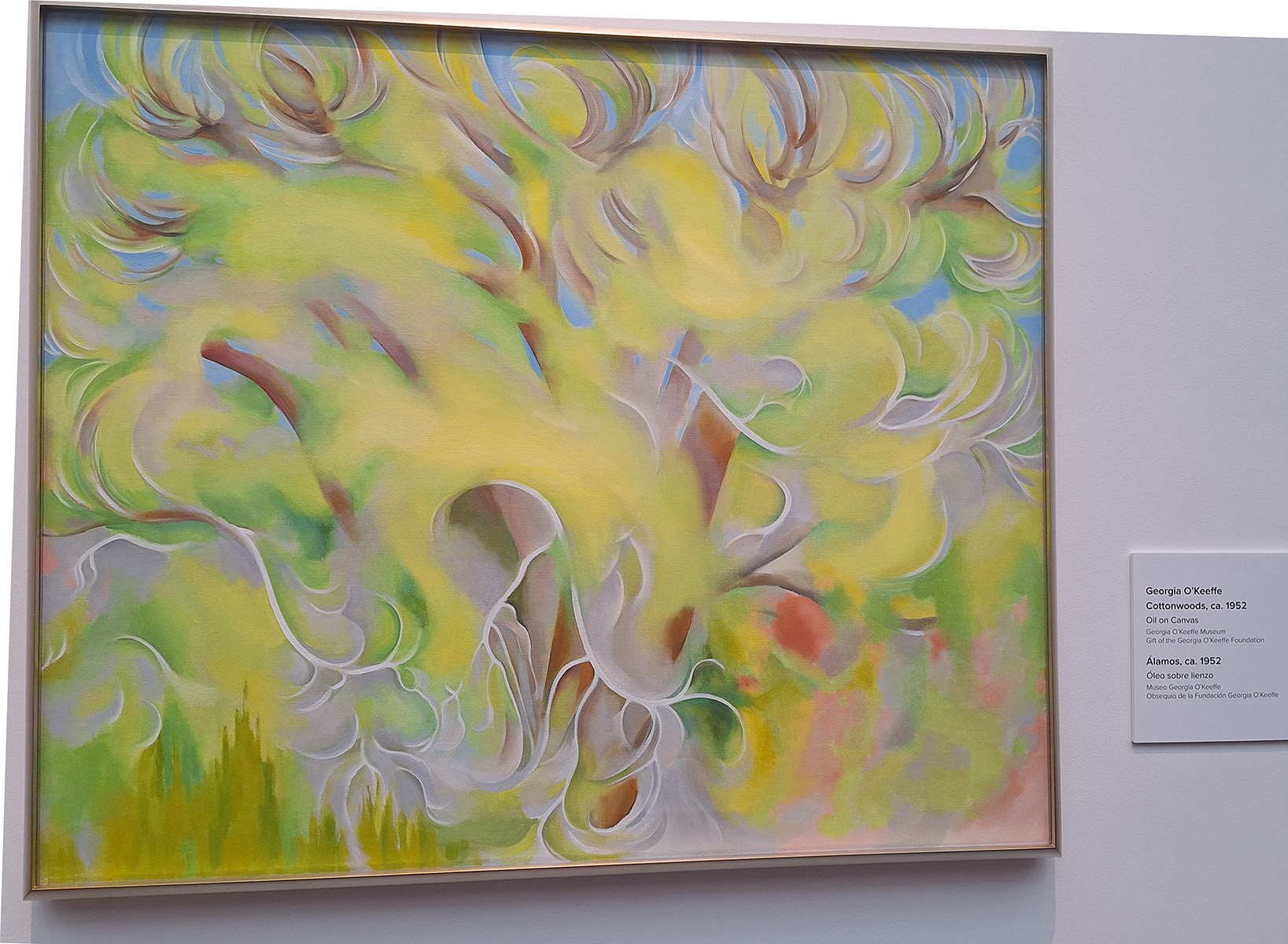
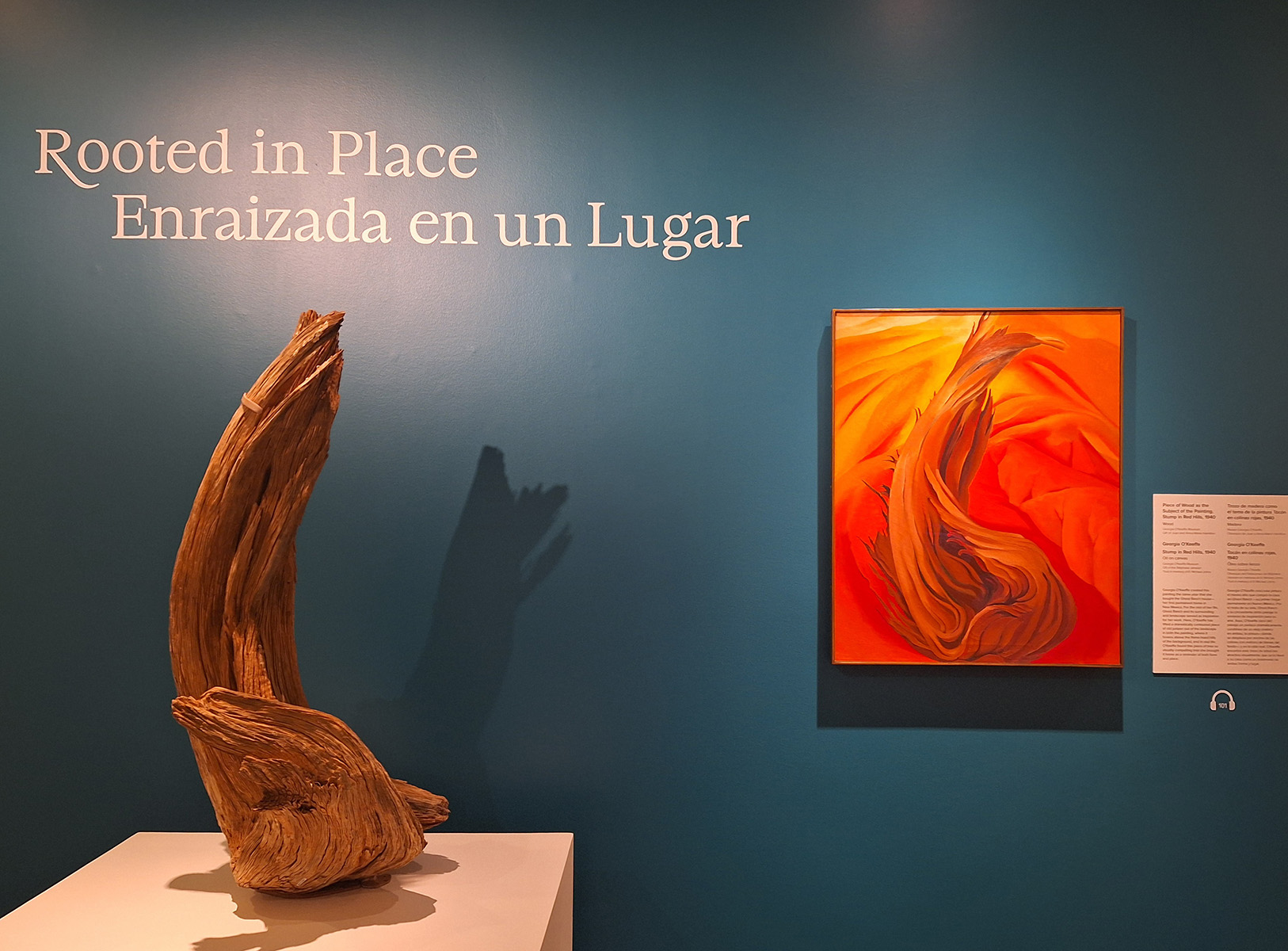
To escape the heat, we took the cool option of visiting the Georgia O’Keefe Museum. It was such a pleasure to view Georgia’s original paintings, seeing her art equipment and reading about her life. I was pleased to see her work so closely. Her life story was fascinating. This encouraged us to visit Ghost Ranch (her home previously) when we travelled north.
Despite being in America, we had French food for lunch. We visited the French Pastry shop that is part of the Hotel La Fonda. The shop is close to the famous Santa Fe Plaza: a large green park surrounded by boutique shops, cafes and restaurants. A ‘must see’ place to visit and chill. Many ornate metal street lamps surround the park draped in long swathes of fiery red chillis baking in the sun.
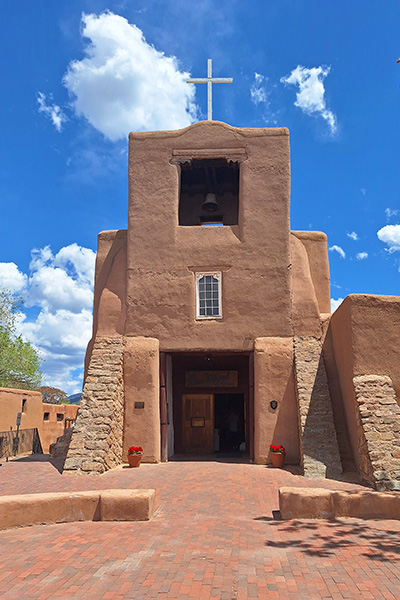
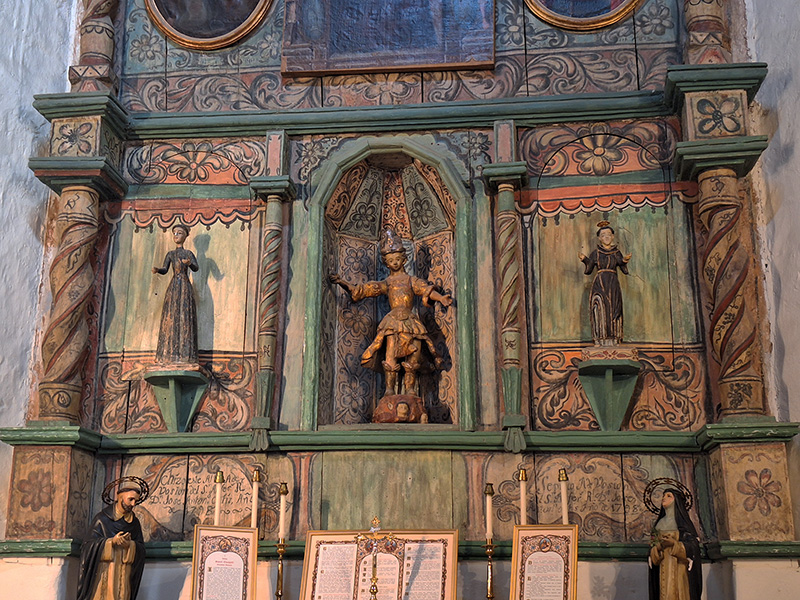
After lunch we walked a few blocks to the main church, the Cathedral Basilica of St. Francis of Assisi. Built in 1869, it is a beautiful church, very welcoming, light and airy. We decided not to visit the nearby Loretto Chapel, famous for its wooden staircase, which some believe created by Joseph of Arimathea himself. Instead we visited the oldest church in America, the San Miguel Chapel. Built by Franciscan missionaries and Spanish Conquistadors in 1610. It’s next to the oldest house in America. Both were built around the same time, created in the Pueblo style of strong thick golden yellow adobe walls. Against the backdrop of a sapphire sky, the church looked absolutely breath-taking. Like a giant sandcastle.
Inside, the church walls are painted with traditional church icons set at the front. We were told the icons had been crafted in Spain and sent by ship to Mexico. Where they were then transported north overland to Santa Fe to be installed in the new frontier church. The enthusiastic church director told us she repairs the church mud walls and roof every year!
Our B&B was very close to a food court called Chomp. It had a good atmosphere, lots of locals use it especially after work. We drank margaritas and ate huge pizzas.
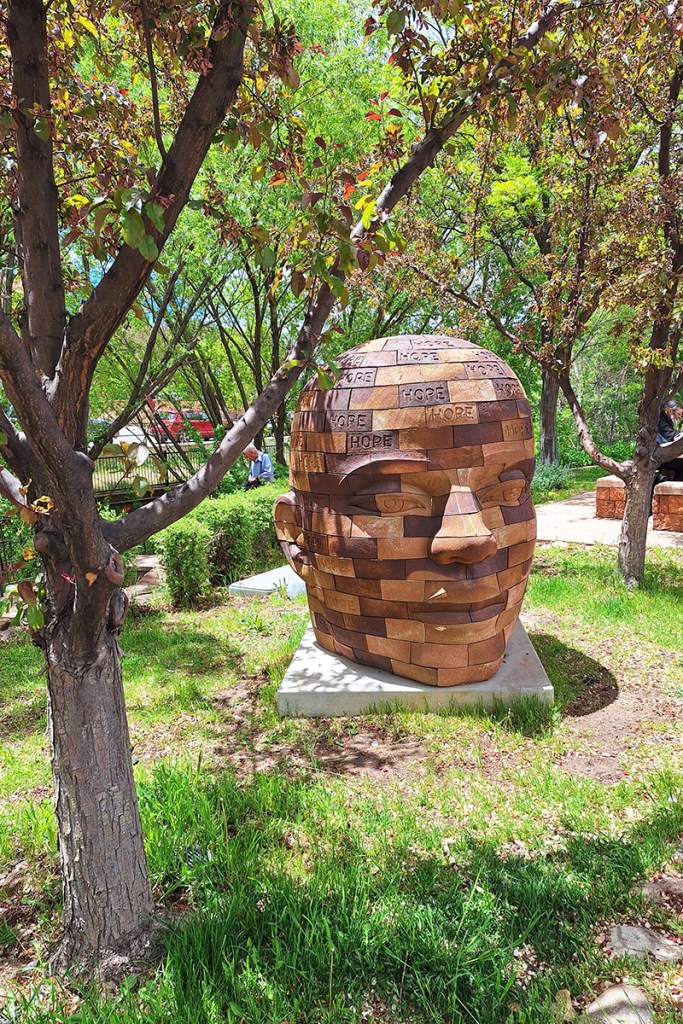
Santa Fe is so ‘arty’. There are some surprising sculptures to see around the town. There are many, many art shops, the old rail yard, the other museums, and the cinema owned by George Martin. I liked the town very much and want to return to explore further.

Thank goodness for ‘Google Maps’. The sat nav I booked along with the hire car didn’t happen. It was a case of first come first served. My husband made sure that I drove on the right side of the road and kept to the speed limits. We kept a close eye for Sheriffs! We headed north on Highway 84 (1 hr 15 mins) to our first stop, Ghost Ranch. It is an Education & Retreat Centre now, but at one time it was the home of renowned artist Georgia O’Keefe.
Ghost Ranch is a 21,000-acre ranch owned by the Presbyterian Church (U.S.A.). The ranch’s mission is to ‘steward a place of great beauty to nurture the human spirit and mind, discover the sacred, and care for creation’. My husband and I loved Ghost Ranch. The place is so peaceful and raw. You leave the highway to drive under a large entry sign, and follow the main road for a few miles, passing a wooden log cabin on the right. It is a recent addition created for the film City Slickers, which was filmed here – as have many other films.
The road curves past a reception kiosk and onward to a large car park sitting in front of the Ranch’s Visitor and Education Centre. We arrived at lunchtime and ate from scrummy $10 lunch boxes whilst watching the Ghost Ranch information film. There are a variety of buildings which include Georgia’s studio. With the stunning hills surrounding us, the place is so beautiful. No wonder Georgia found it so inspirational.
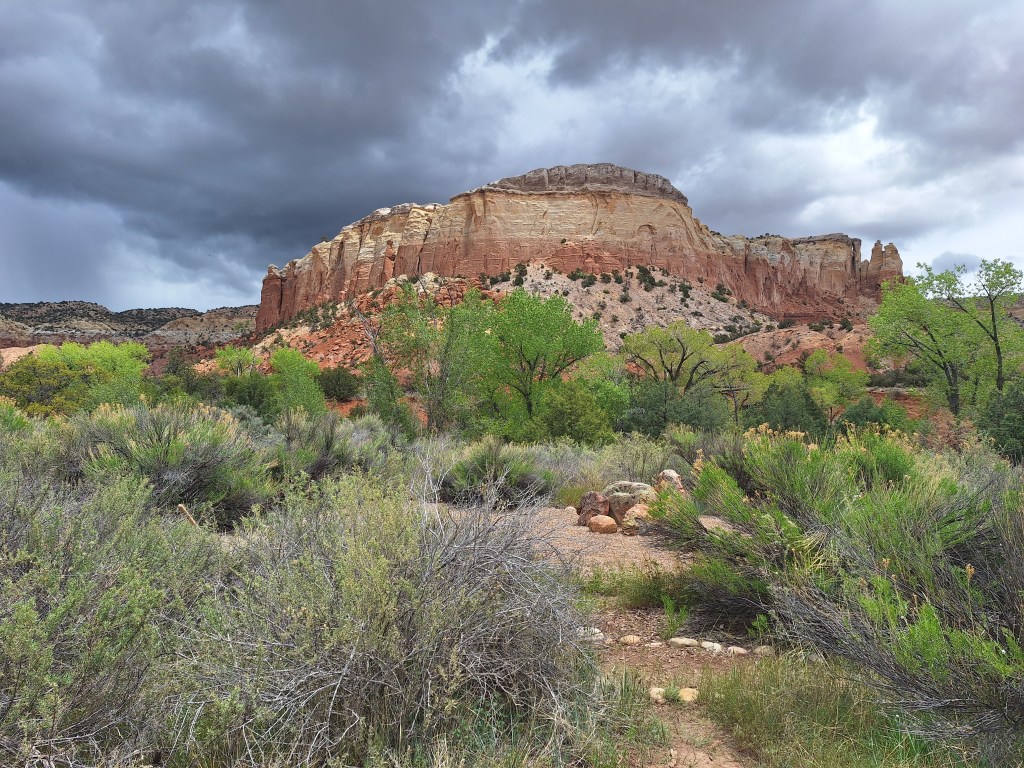
“When I got to New Mexico that was mine. As soon as I saw it that was my country. I’d never seen anything like it before, but it fitted to me exactly. It’s something that’s in the air, it’s different. The sky is different, the wind is different. I shouldn’t say too much about it because other people may be interested and I don’t want them interested.” Georgia O’Keefe.
We stayed as long as we could at Ghost Ranch. But eventually left to continue north. The road climbed higher, and the landscape changed dramatically to fir trees, hills and the distant snowy peaks of the Colorado mountains.
Our next stop, Chama (52 mins away), is famous because of its steam railway, the Cumbres and Toltec railway. We arrived one week before the summer timetable, so sadly no trains were running. Just spent some time looking around the station, line and at the stationary steam trains which were being prepared for the summer runs.
The drive from Chama to Durango in Colorado is about 2 hours. The land changes from scrubland to large green forests. Durango is a small city in SW Colorado on the New Mexico border. Described by ‘Visit the USA’ as “the quintessential Old West mountain town”.
We arrived early evening to stay at the Best Western Plus Rio. An older hotel with an unusual design. A central swimming pool on the ground floor is overlooked by all the floors above! We were given an internal room so needed to draw the blinds on the entry door for any privacy.
The hotel is next close to the famous ‘Durango and Silverton Narrow Railway’ rail yard. My husband, an avid steam train enthusiast, was so delighted to see the trains in the yard as we parked. Time was tight so we rushed out to grab a bite to eat.
Key Tip: Take note most eateries in rural US close around 9-10pm.
I chose the Carver Brewing Company on 1022 Main Avenue for our evening meal based on Trip Advisor reviews. A good decision. After filling our bellies, we slept well, excited for the ride on the Durango & Silverton Railway the following morning.
Day 4 – Steamin’ and a rollin’
People were pouring into the railway station as we arrived at 9am. There was so much noise, chatter, and excitement. The air smelt strongly of oil from the train and warm from the hot steam billowing from the engine. Our train was made up of 13 carriages to carry the great number of people waiting to board.
This railway is a 3ft narrow-gauge operating on 45 miles of track between Durango and Silverton. It was wonderful to ride a steam train on such a long distance. The views are incredible. The track follows a main river going up through canyons, passing large rocks, climbing through tall evergreen forests up to the mountains. The trail starts at an altitude of 6,512 feet above sea level and when it finally arrives in Silverton, an old mining town, it has travelled for 3 hours and reached an elevation of 11,240 feet.
We booked seats in the last carriage, known as the Alamosa Parlor. Built in 1881, this car featured table and chair lounge-style seating for 24 passengers and an outdoor viewing platform. A good choice for any photography and video.
People from all over the US and a few visitors from the UK occupied our carriage. The atmosphere was fantastic. Everyone was looking forward to their trip, many with cameras and ‘go pros’ ready to take photos and video. Drinks and snacks were free. Alcohol and cocktails were available. During the early part of the ride, our guide told us about the railway’s history and celebrity visits. Sadly, we had just missed Harrison Ford, who had been on a shoot earlier that week.
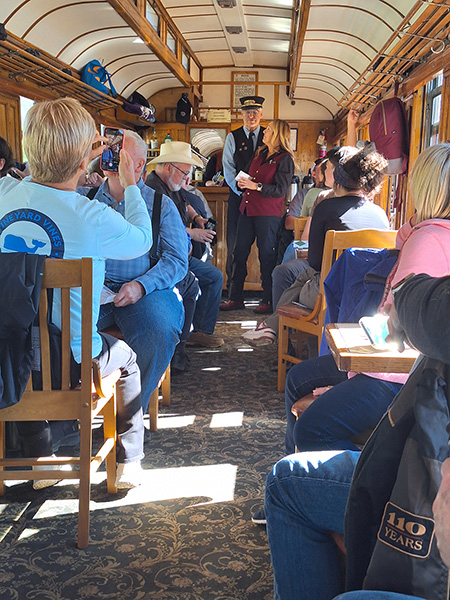
The train offered spectacular views as we climbed up into the mountains. To my joy, the train sounded its horn. One of my favourite sounds, an American steam train giving a lonely echoing whistle.
At one particular point, we watched the 13 carriages ahead of us snaking around a big mountain curve like a giant yellow centipede.
Cameras were snapping, Go Pros recording everything outside and inside. At one point we passed a large rock overhanging the main accompanying ravine. It had been used as a location for a main scene in the classic 1969 film Butch Cassidy and the Sundance Kid.
We were heading to the old mining town of Silverton. The town, founded in 1874, has only one main paved road. It is high up in the Colorado mountains. Many old wooden clapperboard buildings line the main street as shops, cafes and restaurants. But in its heyday, the town consisted of saloons, hotels, bordellos, merchants and banks. It is also famous for having the highest altitude Harley Davidson store in the US. So no wonder you can experience a little breathlessness wandering around Silverton.
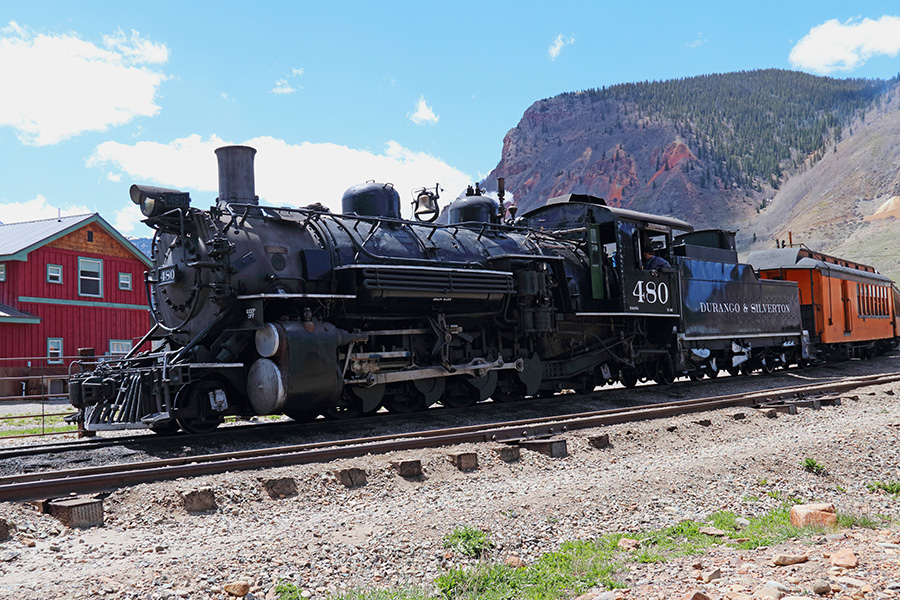
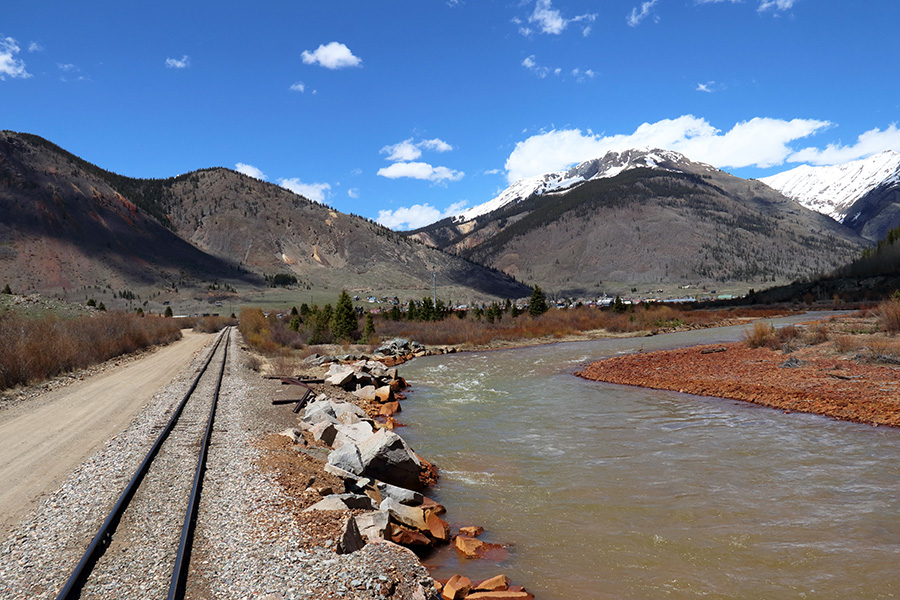
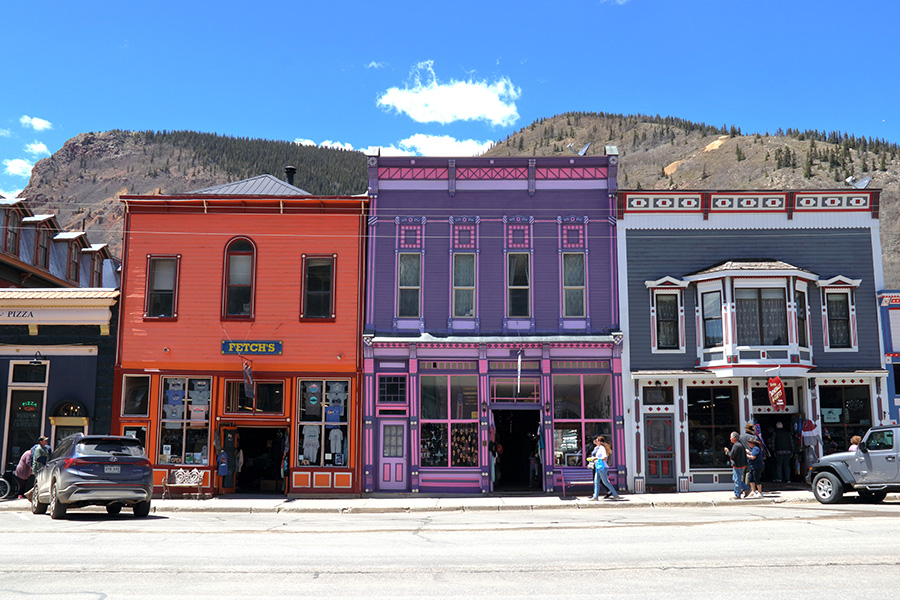
We managed to squeeze in a quick lunch at Silverton’s Pickle Barrel Restaurant, followed by a brief stroll around the town before it became time to board again for the return journey.
It was late afternoon before we arrived back at Durango. Conscious that most restaurants and bars would close at c. 9pm, we quickly selected the ‘Diamond Belle’ bar at the Strater Hotel for our evening meal. The servers were ladies dressed in full saloon gal costume, adding to the real wild west feel of the bar. As we dined, musicians played live music.
Day 5 – Heading West!
Next morning, we visited Durango’s Railway Museum for an hour. Plenty of trains to look at, some models, general vehicles and historical information about Durango and its railroad & mining past. Worth a visit.
We drove to the local garage to fill up on fuel. We had to pay up front to be able to use a fuel pump. You press a button for the fuel you need. As we walked back to our rented car I watched a guy in a large pickup come up behind and run into the back of our car. The front of his vehicle had large bull bars. I admit I was furious but calmed down when we saw there was no damage. The driver of the pickup was an elderly man. He was very laid back and asked if we were English and then spent 5 minutes chatting to us.
Our next stop was Mesa Verde National Park, located 36 miles west of Durango. The park’s name is Spanish for ‘Green Table’. Established by past US President, Theordore Roosevelt, in 1906, this UNESCO site contains over 4,700 archeological sites. These include cliff dwellings, pit houses, pueblos and towers, all built during 550AD to 1300AD. Everyone on the train the previous day said it was a ‘must see’. So we drove there in the hope of entry tickets since we had not book anything in advance. We were successful.
We bought tickets at the visitor centre and drove up the main main road to the top of the earthen table. There are plenty of stops on the top. You can take in the amazing view in all directions. To me, it was a like a scene from a prehistoric film, like ‘The land that time forgot’. It’s a high land looking over miles and miles of plains mountains in the distance. I was just waiting to see dinosaurs to appear.
We travelled the road system and saw as much of the cliff houses as we could from a distance. They are built into cliffs overlooking deep ravines.
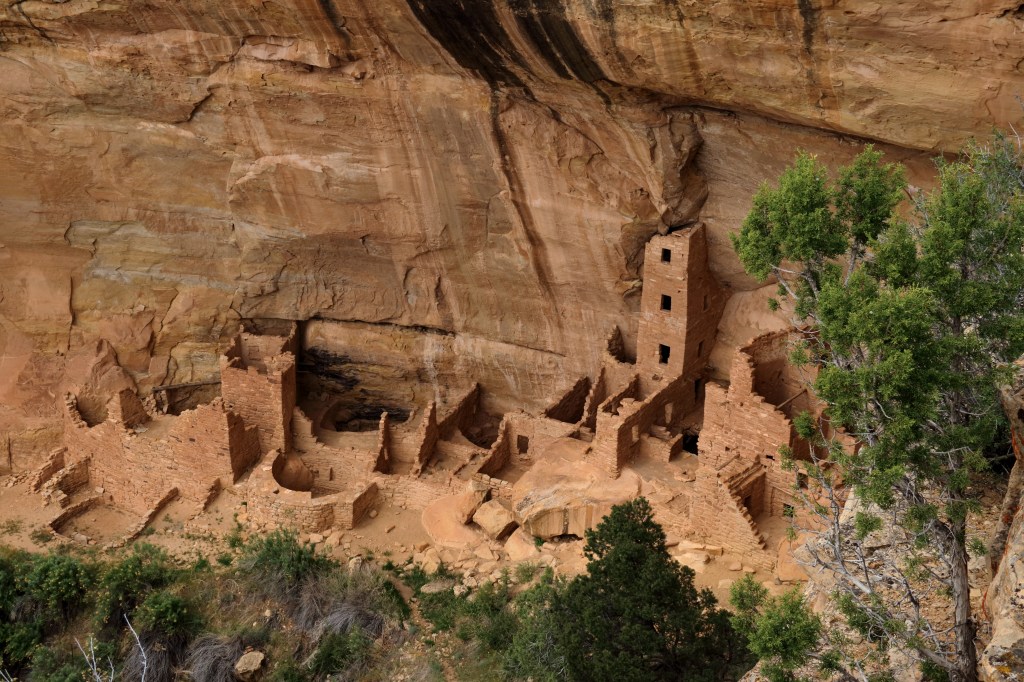
The houses are multi levels. They were built during our dark ages. If you want to tour inside the cliff dwellings, you need to buy tickets (c. £100) for the Ranger tour. Something to do during another visit.
Key Tip: Make sure you have a full tank when driving west. The next town could be at least 50 miles away!
We headed west to Cortez, and then south-west, passing the Canyon of the Ancients to get to our hotel for the night. The Desert Rose Resort & Cabins was a big surprise. It is a huge hotel in a log cabin style along the main highway to Monument Valley. The surrounding landscape was very dry, rocky and dramatic. The land consisted of brown scrubland and dry river beds overlooked by large outcrops of pink and brown blocks of rock. It wasn’t hard to think you were on another planet, say Mars!
The town of Bluff has a population of about 243 people. It owes its existence to the Mormons who first created a settlement there to help establish the Utah state. You can still visit the original fort, which is now a museum. Our place for the night was one of the small lovely log cabins in front of the hotel. It was charming. After visiting the Canyon Smokehouse down the main road to have our evening meal, we sat on our cabin verandah looking at the dark sky above, drinking beer and listening to a fellow guest who played baroque music on a guitar for an hour.
Day 6 – Land of the Navajo
We turned left out of the hotel and drove west. The road was straight, cutting through more dry arid landscape and huge plateaus of pink and yellow rock. After an hour, we could see the tall buttes of Monument Valley in the distance. We drove down the road used in the film ‘Forrest Gump’. The scene where he stops running and begins to turn homeward is a big tourist draw. You have to be careful when driving through in case you hit someone. People are too busy taking selfies in the middle of the road.
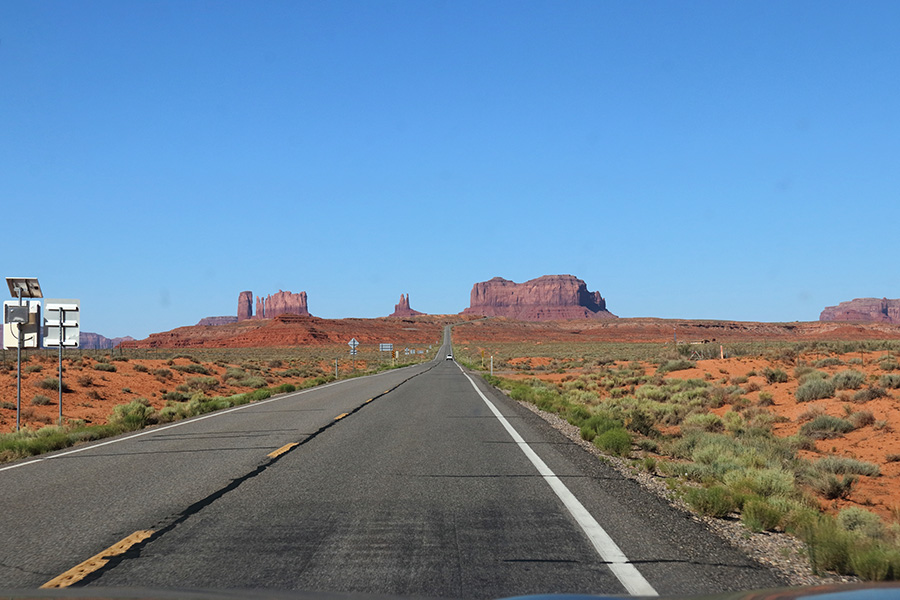
The road to Monument Valley, Highway 163, goes through the town of Mexican Hat. So named because of the large shaped rock, heavily weathered, that resembles a sombrero on the edge of town.
This highway is very modern and very drivable. There are plenty of opportunities to turnoff and sightsee other places. Once you enter the small settlement of Monument Valley, turn left for the small driveway to the main visitor centre.
Monument Valley is part of the Colorado plateau, lying on the Utah/Arizona border. Famous for its cluster of giant sandstone buttes some as tall as 1,000ft. These rock formations were named according to their shapes, by a local entrepreneur named Golding. Names such as: East and West Mitte Buttes, Castle Rock, Stagecoach, King on his Throne, Elephant Butte, Rooster Rock and many more. From the 1930s, this area was often used in media. It was a location for many of John Ford’s classic films such as: The Searchers, She wore a Yellow Ribbon, My darling Clementine and more. This has been popular as a film location for other memorable films like: Easy Rider, Forest Gump, 2001: Space Odyssey, Mission Impossible II, National Lampoon’s Vacation and Cars.
Monument Valley is reservation land, and very sacred to the Navaho, known as ‘Tse Bi Ndzisgaii’ or “Clearing Among the Rocks”. The rocks themselves were not named by the Navajo because they are sacred.
The Monument Valley visitor centre is very large. There is a great deal of parking to cope with the high levels of visitors. There is a hotel too. Many of the jeep tours park at the hotel.
For ease, I booked a jeep tour. This proved to be a great idea. We booked online with Backcountry Jeep Tour with Navajo guide through GetYourGuide. Our tour guide and driver was a lovely lady called Marjorie, a Navajo. Her tanned face gave us a wonderful smile and warm welcome. Making sure we were well strapped in, the jeep left at a lively pace down the main track into the park. A jeep is necessary because the route is a deep rutted mud track of 17 miles. There are private tracks that come off the main one only accessed by tours. At our first stop, we all got out to look at the most amazing and famous view of the Mitten Buttes. It was early May but the land was was warm.
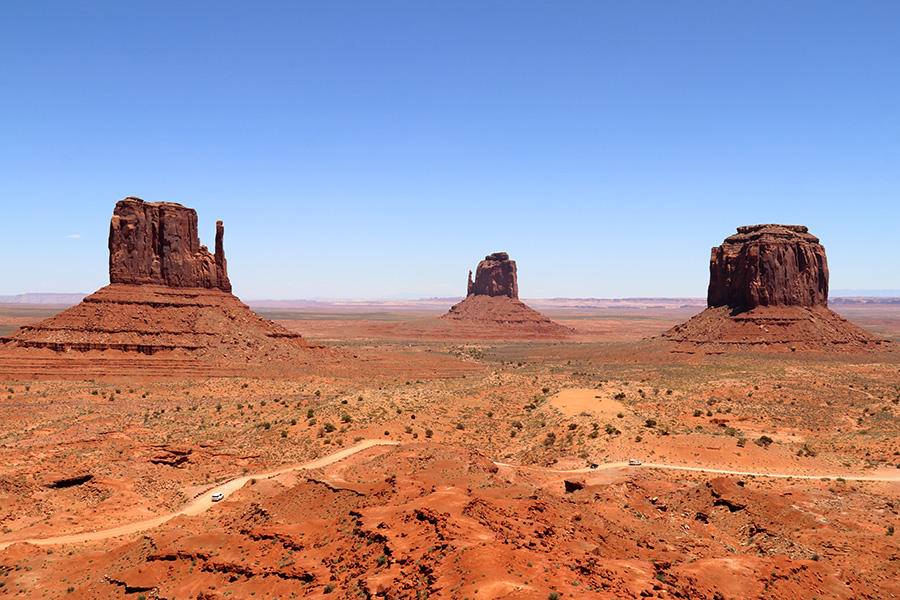
Our guide, Marjorie, informed us about the local history of the area, Navajo traditions and how the local buttes were named. She took our photograph so we had a memento. Stop number two was very famous. It is known as the John Ford Point.
A little further on, our jeep moved onto a private track. This route circled round more large outcrops of rock until we arrived at a Navajo traditional homestead. The main buildings, are known as hogans; constructed out of mud thickened walls which are repaired yearly. These buildings keep the heat in Winter and keep the heat out in the Summer.
We entered a hogan and were introduced to a young lady who talked about native weaving. She mentioned that while growing up she had helped her grandma and the other women with weaving. When old enough she left the reservation for work. But after some time, she returned back her home and took up weaving as she had been taught by her family. She felt that this was where she was supposed to be and was happier for it.
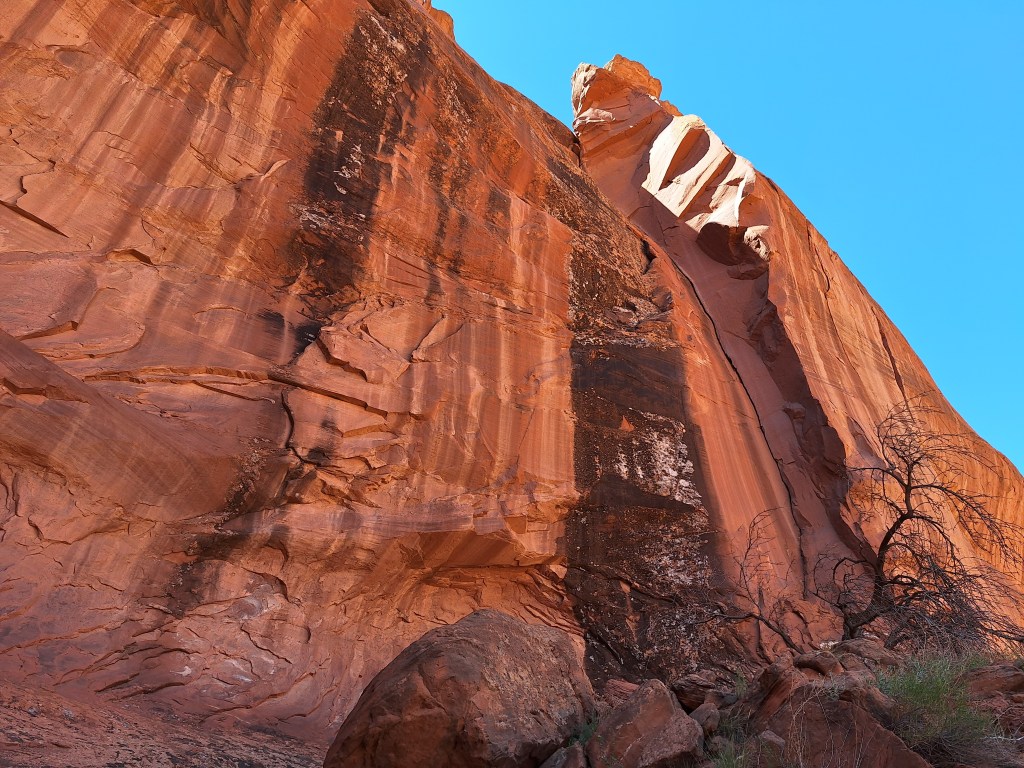
Our final stop was deeper in the valley. Many of the rocks were heavily weathered producing broad arches and deep openings. We were surrounded by rock formations in tones from bronze, peach to grey. Cracks, shattered stone and eroded shapes lay either side of the road. We finally parked in one spot and taken to see the famous ‘Eagle Eye Cave’.
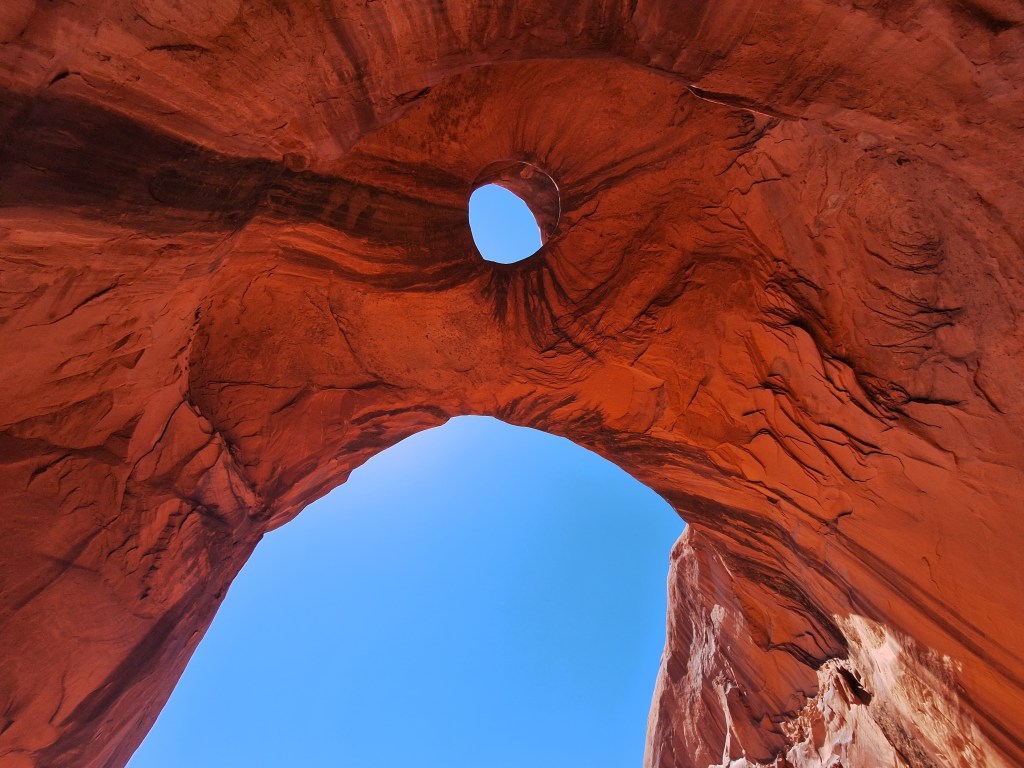
This place was a natural ampitheatre, its walls reaching high to one opening at the top. Using our imagination we could see the shape of a large eagle flying above. This place is very spiritual, you could feel its beauty and a great sense of peace. We waited as another guide, brought an native flute to his mouth and began to play (see video below).
It was a wonderful performance of the Indian flute. Then to our delight, our driver Marjorie sang a Navajo song while tapping a drum.
She told us that her grandfather had been a Navajo medicine man. It was a very spiritual moment. I think that everyone gathered felt it. We were shown places to photograph and heard stories about the land.
Late in the afternoon, after visiting the cafe and shop at the tourist centre, we turned back to drive eastwards to Bluff.
We toured round the old Bluff Fort in the town. We met by an older married couple who were managing the site. They were retired, and had been sent by the Mormon church to look after the site for 6 months. The gentleman was fixing things and doing general maintenance around the site. He told me that he had been to the UK when he was younger to spread the word in the East End of London. He was charming with a twinkle in his eye.
The couple were very friendly and happy to answer questions about the site’s history. We were told that the Mormon Church, in the early days, had asked young people of their faith to marry and travel across a stark landscape heading east across wide difficult rivers, rough terrain, and through Indian country to establish a new town – Bluff. This venture involved 260 people, travelling for 6 months to finally build a new community that would meet the requirements of creating a new American state – Utah. They achieved this goal. Surprisingly no one died but a few babies were born along the way.
We continued on to Farmington. Sometimes our view was just an endless road in the distance. A few times, we laughed and said “Are we nearly there yet!” It seemed a never-ending drive. As we got closer to Farmington, we could see Shiprock, a famous sacred native American site. Microsoft used an image of this iconic place as a screen saver on their Windows software. I always loved the photo.
Our hotel for the night was the Farmington Comfort Suites Hotel. The reception were very very helpful. There was a small shop on site so we could buy water. Our room was lovely.
Day 7 – Return to New Mexico
From Farmington we drove cross country to Ghost Ranch (Route 64 and south on Route 84). We decided to lunch again at the Ranch and enjoy the valley once again before driving south to Santa Fe. This was our last day of sightseeing.
As we drove south we saw signs for Los Alamos. This place is mainly famous for the creation and development of the Atomic Bomb during World War 2. We had considered visiting but both felt too tired.
Our last evening was at the Hyatt Place in Sante Fe. The hotel is on the outskirts near the main road to the airport. It is a lovely hotel with good service.
For our last night in New Mexico we visited a New Mexican restaurant called Tomasitas. This restaurant is well starred in Trip Advisor. It runs a ‘first come first served basis’. Situated next to the Santa Fe Depot (railway), there is plenty of parking. The service was excellent as was the food.
Day 8 – Homeward bound
After a good night’s sleep and a super breakfast, we checked out of the Hyatt Place and drove our hire car to the airport. Dragging our bags, we checked in the terminal and waited for our flight to Denver which was due around midday. We experienced no problems flying north and then catching our connecting flight to London Heathrow.
In summary
This trip took two years to plan. I had no knowledge of the area at all. I relied on information I found online, comments from the Facebook group and travel books. The whole visit to South West America was a challenge in both creating and experiencing. My husband and I grew with confidence as we travelled. Everything was new to us. But with each day, our enjoyment of our adventure grew.
Looking back, we feel happy that we did this trip and want to go back and explore more.
I hope you enjoy reading my blog.
Gill
It’s all in the Planning
Places visited during the trip.
- Santa Fe Airport.
- The Parador Hotel, Santa Fe
- Chomp, Santa Fe
- Santa Fe Cathedral Basilica of St Francis of Assisi
- San Miguel Chapel
- Santa Fe Plaza
- El Charro Restaurant
- Georgia O’Keefe Museum
- French Pastry Shop
- Cathedral Basilica of St. Francis of Assisi.
- San Miguel Chapel.
- Ghost Ranch
- Cumbres & Toltec Railway
- Durango and Silverton Narrow Gauge Railway
- Mesa Verde
- Canyon Smokehouse
- Monument Valley
- Bluff Fort
- Tomasita’s Restaurant
Hotels
- The Parador Hotel, Santa Fe
- Best Western Rio, Durango
- Comfort Suites, Farmington
- Hyatt Place, Santa Fe
Planning – Important Steps
- Book the flights as early as possible to get the best deal. My choice was – London Heathrow to Denver. Denver to Santa Fe. Booked through Trailfinders.
- Get ESTA approvals (US Tourist Visa).
- Book car hire (used Booking.com). There are car hire extras and insurance. I booked all of it though I did find out that some people take out UK insurance that covers these items. I am told it is cheaper.
- Book accommodation for the trip (used Booking.com).
- Book travel insurance – double check the small print for ‘Expatriation’ cover. Will the insurance cover you being flown home?
- Medication – get copy of your scripts in case of any enquiries at US Security
- Obtain International Driving Licences and have valid UK driving licences. Some states require International Driving Licences.
- Organise US dollars, debit card with USD on them. I used Post Office card also but did experience in one place where the card would not work.
#santafenewmexico #utah #travel #colorado #photography #steamrailway #heritagerailway #monumentvalley #arizona #utah #usa #roadtrip #travel #navajo #navajonation #travelphotography #monumentvalleynavajotribalpark #landscape #nature #landscapephotography #georgiaokeefe

 High Days and Holidays